Keep a complete claim file
Save letters, estimates, receipts, inventories, and written explanations. A clean file makes it easier to answer questions or challenge factual errors.
Read the policy section tied to the dispute
Match the claim issue to the covered peril, exclusion, deductible, valuation method, sublimit, or condition actually involved.
Create a claim timeline
For claim depreciation, organize the event, notice to the landlord or insurer, evidence, expenses, and claim communications chronologically.
- Loss date and time.
- Claim number and adjuster.
- Photos, receipts, and item list.
- Requests and response dates.
ACV versus replacement-cost guide
Direct answer for this situation
Actual cash value generally reflects depreciation, while replacement-cost coverage is designed around the cost of a comparable replacement subject to policy terms. Do not assume replacement-cost value is always paid up front; ask how initial payment, depreciation, replacement proof, limits, and deadlines interact.
Questions that change the answer
- How is depreciation calculated for each property category?
- Is recoverable depreciation paid only after replacement?
- What replacement deadline and documentation rules apply?
- Does the coverage limit cap payment before or after the deductible calculation?
Use a record, not memory: save the policy form or written answer that resolves each question.
Worked example
Illustration only: a comparable replacement costs $1,200, estimated depreciation is $450, and the property deductible is $500. An ACV-style starting calculation could be $250; a replacement-cost ceiling could be $700. The actual claim may differ because policy language, limits, depreciation methods, and settlement procedures control.
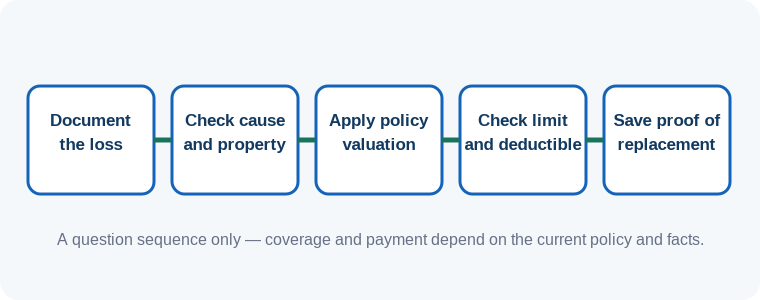
Evidence checklist for Claim Depreciation
- Original item and condition
- Current comparable replacement
- Depreciation explanation
- Initial claim payment
- Replacement invoice and submission deadline
Sources and further reading
These sources support the general education above. The issued policy, endorsements, insurer claim communications, and facts of a loss control an individual coverage decision.
- NAIC renters insurance consumer insight — plain-language ACV and replacement-cost explanation
- NAIC post-disaster claims guide — claim valuation examples
Related guides
Sources and further reading
Use public insurance resources and your policy documents to confirm definitions, consumer contacts, and coverage limits before buying or filing a claim.
Apply claim depreciation to a real policy
Treat claim depreciation as a documented timeline. Report the event promptly, protect people and property, prevent reasonable additional damage, and preserve evidence. Do not guess about cause, ownership, or value; identify what is known and what still needs verification.
A claim is a documented request for the insurer to apply the policy to a specific event. Prompt notice, a consistent timeline, proof of ownership and value, mitigation, and written explanations help the renter understand the decision.
Details that can change the answer
- notice deadline
- covered cause
- proof-of-loss requirement
- valuation method
- appeal or complaint path
Documents and evidence to keep
- claim number and contact log
- photos and videos
- itemized inventory
- receipts and estimates
- decision letters
Read the contract in this order
- Confirm the insured name, address, policy period, limits, deductible, and endorsements on the declarations page.
- Find the coverage grant and identify the event or property it addresses.
- Read the definitions used by that section.
- Check exclusions, exceptions, special limits, and duties after loss.
- Read every endorsement that changes the base policy.
- For a claim, ask for a written explanation that cites the policy language and calculation.
Comparison table
| Compare | Record | Verify |
|---|---|---|
| Coverage | Covered cause, property or liability interest, and location | Definitions and exclusions |
| Money | Limit, sublimit, deductible, and valuation | Declarations and settlement conditions |
| Evidence | Timeline, ownership, value, and mitigation | Claim instructions and written requests |
| Alternatives | Endorsement or separate policy | Current state and address availability |
Questions renters ask
What should a renter check about claim depreciation?
A claim is a documented request for the insurer to apply the policy to a specific event. Prompt notice, a consistent timeline, proof of ownership and value, mitigation, and written explanations help the renter understand the decision.
How to claim depreciation on insurance claim?
Start with the declarations page for limits and deductibles, then read the definitions, coverage grant, exclusions, conditions, and endorsements that apply to the event. Ask the insurer to identify the controlling language when the answer is unclear.
How to handle a claim depreciation?
Keep the current policy form, declarations, endorsements, dated photos, receipts, and written communications together. For a claim, preserve the event timeline and ask before discarding damaged property when practical.